

Quarterly Review
Q2 2026 was the best quarter for global equities since 2020. Global equity markets were driven by two dominant forces: the unwinding of the Iran war premium on oil, and an accelerating AI investment boom. That oil reversal was the catalyst, acting as a relief valve for inflation fears, rate expectations, and risk appetite simultaneously.
The shape of the quarter matters more than the headline number. Through April and much of May, our portfolio continued to experience the multiple contraction that has defined the past two years, primarily due to long/short AI trades, where shorting quality and value finances further investment in AI-related companies. Almost every incremental dollar committed to the AI theme has directly pressured the kind of businesses we own. That turned in the second half of June, when the first genuine signs of a rotation back to quality propelled the portfolio to outperformance. The move continued through July and into August.
Is the Rotational Bounce the Start of a Trend?
The obvious question is whether what we saw in late June and July is the beginning of a durable rotation, or a pause before AI dominance reasserts itself. Our view is that as the economics of the AI model become more apparent, and perceptions collide with reality, investors will move from the speculative unknown to the fundamentally proven.
It is worth reviewing how we can outperform from here. We see three distinct paths, and only one of them requires a crisis:
1. If AI goes sideways, we win. Our portfolio has had a strong inverse correlation to the long/short AI momentum basket. That relationship was on display in the June reversal, and it means the AI trade does not need to break for us to gain; it merely needs to stop compounding.
2. General economic strength lifts non-AI companies. Our holdings are levered to the real economy. Broad-based earnings recovery outside the AI complex flows directly into our results.
3. A dislocation in AI valuations realigns capital toward quality. This is the least pleasant path and the most powerful. Capital displaced from a crowded theme has historically found its way into cash-generative businesses trading at depressed multiples.
Our positioning is favourable across all three, and this asymmetry is the practical result of holding a portfolio of profitable, extremely cheap, cash-generative businesses through a period when the market has not wanted to own them.
Current Market Environment
The dominant feature of this market is not valuation or sentiment. It is liquidity. Between expansionary fiscal policy, interest rates that are neutral-to-easy (relative to nominal GDP growth), and the sheer magnitude of corporate capital expenditure, the markets are awash with money. Based on our research, the combination of US fiscal deficits and corporate capital expenditures (capex) will reach nearly 12% of US GDP this year and continue rising over the next three years, to levels not seen outside a crisis or world war.
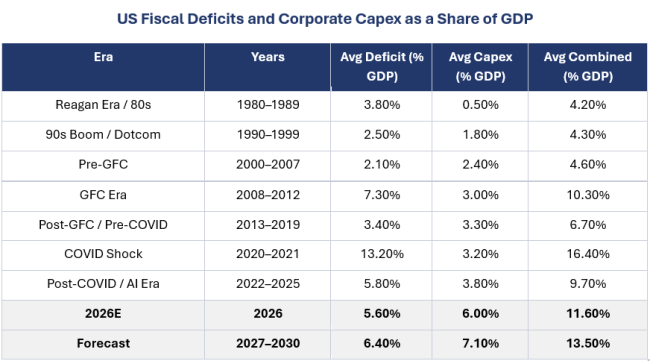
The practical implication is uncomfortable for the cautious: as long as capital and credit are available, markets will trend higher. Liquidity of this magnitude does not respect valuation discipline, as witnessed for the last two years.
What we regard as the most important development of the quarter is that these easy-money conditions are starting to leak out of the narrow AI channel and lift other industries. We are seeing improved sales and earnings growth from "other than AI" companies (including our portfolio) that have been moving sideways for almost two years.
A market crash requires more than an expensive market. It requires valuations at extremes, credit overextended, and liquidity meaningfully reduced. The first two conditions are arguably in place. The third is not, and there are only three plausible routes to it: 1) government adopting deficit-fighting policies in the manner of the 1980s and 1990s, which we consider unlikely; 2) the Federal Reserve initiating a genuine tightening programme, as it did into the dotcom peak, which is possible; or 3) the hyperscalers holding or reducing their spending, which is also possible. We are watching the third most closely because it is the one decided in a handful of boardrooms rather than in the economy.
The AI Trade: Priced on Unknowns
Before turning to the quarter's AI debate, a word on why we are spending time on a theme we have deliberately not owned. AI is not just an important technology; it has become critical to the world's equity markets and global economic growth. The AI build-out is a capital-expenditure cycle, which is our core focus. The application of our expertise now serves two purposes. The first is risk management: where AI goes, so go the markets and the global economy, and we need to manage exposures. The second is opportunity. The AI build-out will have long-tail effects on markets and investor returns, and somewhere in those effects are businesses we will want to own. We believe that good things happen when preparation meets opportunity.
Now on to our latest thoughts on the AI trade. The June and July previews of a rotation back to quality stemmed from market concerns about the AI model. With trillions of dollars committed upfront to data centres, chips, and power, the key question is simple: does AI monetisation ramp fast enough to cover the cost of capital before the assets depreciate, or is this an enormous overbuild that will never prove profitable?
The financing of the build-out is made possible by exactly the easy-money conditions described above, but this cannot last forever because demand inevitably drives up the cost of capital. Consensus has the largest hyperscalers spending ~$800 billion on capital expenditure in 2026, a figure roughly equal to 100% of their operating cash flows, and the sell-side estimates a cumulative capital effect of $7.6 trillion between 2026 and 2031 across compute, data centres, and power. Spending on that scale, increasingly funded through the corporate bond market, is a bet on a massive payback profile that nobody can explain. In our opinion, there are too many unknowns to price the AI model properly. The speculative buyer, however, is free to assume the most favourable outcome, but it reliably produces overinvestment and extended markets in both credit and equity. Uncertainty of this kind does not get priced conservatively during a boom; it gets priced optimistically and revised down violently.
Underneath the pricing question sits a structural oddity that we think is under-appreciated. In most businesses, profit margins are highest for the owner of the end-customer relationship. In current AI models, the opposite is true: margins improve the further you get from the end user, and the layer that touches the customer is the one that loses money. This means the AI boom's revenues are currently being funded by investors rather than earned from customers. The upstream margins are real, but they are paid for out of capital raised by the layer losing money, not out of cash generated by end demand. For context, an industry generating roughly $80-90 billion of annual AI software revenue is supporting close to $1 trillion of annual spend. The bottom line is that the most profitable part of the AI value chain depends on the least profitable part continuing to grow revenue or raise capital. Capital can bridge that gap for a while, but not indefinitely, leaving it unclear whether end-customer ROI will materialise fast enough to sustain upstream margins.
This dynamic directly impacts software companies and perceived AI losers, which had a difficult start to the year. The January release of Claude Cowork was perceived as a direct threat to software businesses, and the narrative shifted from "software will eat the world" to "AI will eat software." Palantir's chief executive reinforced this in February, arguing that AI had become powerful enough to make many SaaS companies irrelevant. However, post-quarter-end, July saw a marked rotation out of AI winners and back into stocks previously perceived as AI losers, including software. Three factors drove this shift:
1. Open-Source Disruption & Pricing Power: Current prices for frontier models can only go down as open-source, smaller, task-specific models drag margins lower. These models run far more cheaply while performing close to US frontier labs, and self-hosting in the US materially reduces data-transfer risk. This is already a reality: Chinese open-source models reportedly accounted for c.46% of US enterprise token usage by July. Open-weight LLMs shift pricing power away from frontier labs, softening the bear case that per-token model costs would eat software margins.
2. IP Theft Risk and Weak ROI on Frontier Token Costs: High-profile CEOs at companies like Palantir, Microsoft,and Uber have become increasingly vocal about the risk of IP theft and high frontier-model token costs undermining returns.
3. Software Companies are Responding: SaaS leaders are launching their own AI products.
The negative narrative around terminal value has not fully faded, but our three SaaS holdings are well positioned and have executed strongly over the past two years, compounding revenue growth while expanding margins. We continue to expect software companies will be challenged by AI, particularly point solutions. But those exposed to cybersecurity, and those serving as their customers' systems of record are well placed to benefit under the complexity-ladder framework we set out last quarter.
Portfolio Activity and Fundamentals
Portfolio activity was again above average in Q2 2026 as we continued to leverage dislocations to improve the portfolio's quality and resilience. At quarter-end, the portfolio held 21 long investments, with gross exposure of 96% and the top ten positions accounting for 60% of NAV. Our largest single investment was 8%. Strategic currency hedging remains in place, with the portfolio maintaining approximately 25% long exposure to non-USD currencies, reflecting our view of relative currency valuations.
Our portfolio has continued to cheapen while the market has become more expensive. Since June 2024 our price-to-free-cash-flow multiple has fallen while the MSCI World’s has risen, and we now trade 39% below the market on that measure, with roughly double the cash return on equity.
Our Foundational Formula remains: Total Shareholder Return = Owner Earnings Growth + Dividend Yield + Change in P/E Multiple.
On that framework, our projections include mid-teens annual owner earnings growth, and a high single digit expansion in the price-to-earnings multiple over the next three years. Our multiple recovered somewhat over the quarter, narrowing the gap back to historical averages. We expect these twin engines of return, plus a modest dividend, to deliver an outsized annualised return over the next three years. The current dislocation between our portfolio's earnings trajectory and its stock price performance cannot persist indefinitely. As returns converge with EPS growth, we anticipate significant outperformance.
Closing Remarks
The second quarter recovered a meaningful portion of the first quarter's loss and, more importantly, produced the first hard evidence of what a rotation back to quality is worth. Our portfolio remains extremely cheap, trading at a 39% discount to the market on free cash flow, and presents significant upside, at growth rates 2x higher than the market.
We want to close on the risk that underlies all of this, because it is now the defining feature of the world economy rather than merely the equity markets. The world keeps putting more eggs in the AI basket. Technology companies and now countries are spending hundreds of billions of dollars to meet AI computing needs, issuing billions of dollars of debt and equity to fund the build-out. That rapid infrastructure programme is powering huge amounts of construction, hiring, and trickle-down spending, which feeds companies directly and now links a widening circle of businesses indirectly to AI. The resulting rise in stock prices in turn fuels household wealth and consumer spending. The top 20% of US households own nearly 70% of financial assets, and their spending contributed roughly 1.1% to 2025 GDP growth.
Combined, these factors are dominating world GDP growth and creating concentration risk on a scale we have not seen before. The economy is no longer merely exposed to AI equity prices; it is exposed to the AI capital cycle continuing at its current pace. Should any part of that chain fail (monetisation disappointing, credit tightening, or the hyperscalers simply choosing to spend less), the consequences would extend well beyond the technology sector, into construction, employment, consumption, and the fiscal arithmetic that depends on all three. We do not know when, or whether, that happens. We do know that the appropriate response to a concentration risk you cannot hedge is to own the assets that do not depend on it, at prices that already assume disappointment. That is what we own.
We remain fully committed to the process that delivered our long-term track record, and we are positioned for the recovery we believe is underway. Thank you for your continued trust and partnership.
Note
This is a redacted version of CDAM's Q2 2026 Investor Newsletter. Should you be interested to learn more, please contact us by emailing ir@cdam.co.uk.
Disclaimers
This document and any attachments are intellectual property owned by CDAM (UK) Limited and are protected by applicable copyright and trademark law.
Certain information herein has been obtained from third party sources and, although believed to be reliable, has not been independently verified and its accuracy or completeness cannot be guaranteed.
This material is not an invitation to subscribe for shares or interests in any fund and is by way of information only. The information is as of the date(s) indicated in this document, is not complete, is subject to change, and does not contain certain material information regarding any CDAM investment strategy, including tax consequences and risk disclosures. No investment strategy or risk management technique can guarantee return or eliminate risk in any market environment.